In today’s furniture industry, material selection plays a crucial role in determining not only aesthetics but also durability, production efficiency, and long-term performance. One of the most important decisions furniture manufacturers, carpenters, and interior designers face is choosing between pre-laminated boards and manual lamination.
Both lamination methods are widely used in residential and commercial furniture, yet each comes with distinct advantages and limitations. Understanding these differences helps in selecting the right solution based on project scale, budget, and design requirements.
Understanding the Importance of Lamination in Furniture
Lamination for furniture is not just about surface appearance. It plays a critical role in protecting core boards such as MDF, particle board, and plywood from scratches, moisture, heat, and everyday wear.
Furniture laminates enhance durability, simplify maintenance, and ensure visual consistency across large installations, especially in modular and commercial furniture applications.
To understand the basic lamination process for furniture, it is important to know how decorative layers are bonded to engineered wood boards.
What Are Pre-Laminated Boards Used in Furniture Manufacturing?
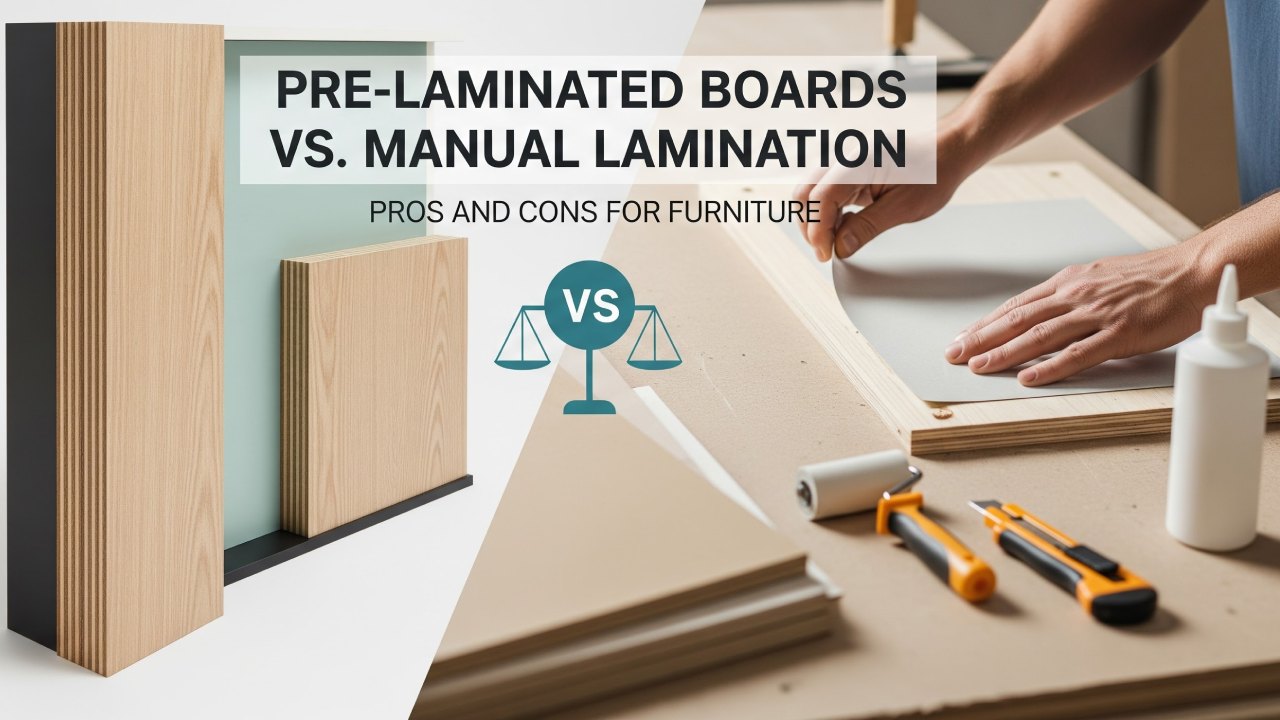
Pre-laminated boards are factory-finished panels where laminate sheets are bonded to boards under controlled conditions of heat, pressure, and adhesive application. These boards are supplied ready to use, eliminating the need for on-site lamination.
They are commonly used with decorative laminates for furniture in modular manufacturing setups.
Common Applications
- Modular wardrobes
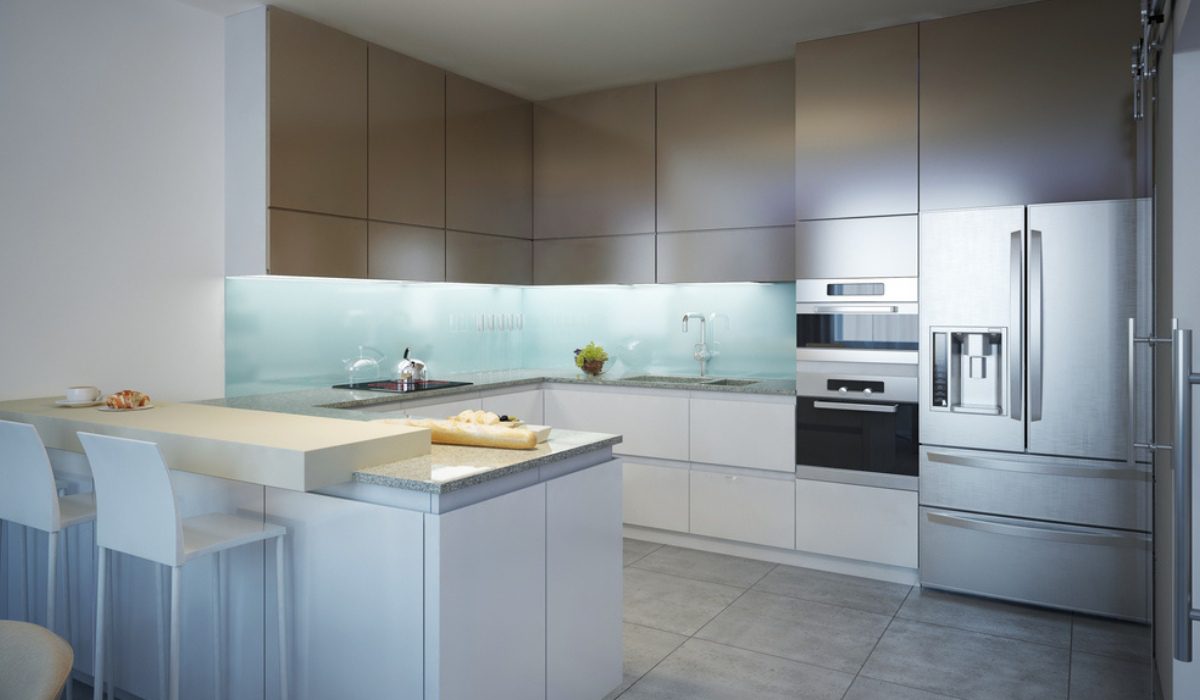
- Kitchen cabinets
- Office furniture
- Retail fixtures
- Storage units
What Is Manual Lamination for Furniture?
Manual lamination involves applying laminate sheets to raw boards at the workshop or site using adhesives and pressure rollers or presses. This method requires skilled workmanship to ensure proper bonding and surface finish.
Manual lamination is often preferred for custom furniture, bespoke designs, and low-volume production where flexibility in design selection is essential.
Pre-Laminated Boards vs Manual Lamination: Key Differences
| Aspect |
Pre-Laminated Boards |
Manual Lamination |
| Process |
Factory-finished |
On-site or workshop application |
| Finish Quality |
Uniform and consistent |
Depends on workmanship |
| Time Required |
Fast installation |
Time-consuming |
| Design Flexibility |
Limited |
High |
| Labour Dependency |
Low |
High |
Pros of Pre-Laminated Boards for Furniture
Consistent Surface Quality
Factory-controlled processes ensure uniform adhesive spread and pressure, resulting in smooth, bubble-free surfaces across all panels.
Faster Production and Installation
Pre-laminated boards arrive ready to use, significantly reducing manufacturing and installation time, making them ideal for modular furniture systems.
Cost Efficiency at Scale
Although initial material cost may be slightly higher, reduced labour, minimal wastage, and fewer errors make pre-laminated boards economical for large projects.
Compatibility with Modular Furniture
Pre-laminated boards work seamlessly with CNC machines and automated edge banding, making them ideal for modern factory production.
Cons of Pre-Laminated Boards
- Limited finish customisation
- Surface damage often requires full panel replacement
- Less flexibility for bespoke furniture designs
Pros of Manual Lamination for Furniture
High Design Flexibility
Manual lamination allows selection from a wider range of laminate designs, textures, and finishes, making it suitable for custom furniture.
Easier Repairs
Damaged laminate surfaces can often be replaced without changing the entire board.
Ideal for Low-Volume Production
Manual lamination works well for one-off furniture pieces, renovation projects, and artisan craftsmanship.
Cons of Manual Lamination
- Labour-intensive process
- Finish quality depends on skill level
- Higher risk of air bubbles and adhesive failure
- Longer production timelines
Durability Comparison: Pre-Laminated Boards vs Manual Lamination
Pre-laminated boards generally offer better consistency in scratch resistance, moisture resistance, and long-term performance due to factory bonding.
Manual lamination performance varies depending on adhesive quality and workmanship. For more information on engineered wood boards used in furniture, material selection plays a key role.
Cost Comparison for Furniture Lamination Methods
Pre-laminated boards are cost-effective for large-scale production due to reduced labour and wastage, while manual lamination may suit smaller projects with limited quantities.
Sustainability Impact of Furniture Lamination Methods
Factory-finished pre-laminated boards typically generate less waste and reduce on-site adhesive usage, supporting sustainable furniture manufacturing practices.
Which Lamination Method Is Better for Furniture?
Choose pre-laminated boards for modular furniture, commercial installations, and large-scale manufacturing. Opt for manual lamination when design flexibility and customisation are priorities.
Frequently Asked Questions
Which is better for furniture: pre-laminated boards or manual lamination?
Pre-laminated boards are ideal for modular and large-scale furniture, while manual lamination suits custom and bespoke furniture projects.
Are pre-laminated boards durable?
Yes, they offer consistent durability, scratch resistance, and moisture protection when manufactured under controlled conditions.
Is manual lamination cheaper?
Manual lamination may have lower material costs but higher labour and time costs, making it less suitable for large projects.
Read More